
2 AWG Cable – 35 mm² Copper, Factory Direct
2 AWG cable is a standard copper size for high-current battery and welding circuits, with a cross-section of approximately 33.6 mm² (commonly rounded to 35 mm² nominal). It sits directly below 2/0 AWG (≈67.4 mm², nominal 70 mm²) on the cable size chart, and the two gauges are frequently compared for battery bank and inverter sizing.
This page covers a specifications quick-reference table, ampacity data for both battery and welding use, a direct 2 AWG vs 2/0 AWG buying decision, and answers to the six questions we get most from procurement teams sourcing 2 AWG cable by the foot.
SAE J1127 · 99.9% pure copper · ISO 9001 certified factory · SGS-verified supplier · Factory-direct · Reply in 12 hours

Get my quote in 12h — send your application (battery or welding) and target length.
2 AWG Cable Specifications
This table pulls directly from our production spec sheets for the 2 AWG battery cable, its 2/0 AWG counterpart, and the 2 AWG EPDM welding cable. Note that battery and welding constructions use different unit builds even at a similar nominal size — this is expected and is called out explicitly rather than merged into one number.
| Spec | 2 AWG – Battery Cable | 2/0 AWG – Battery Cable | 2 AWG – EPDM Welding Cable |
|---|---|---|---|
| Cross-section | 33.6 mm² exact (35 mm² nominal) | 67.4 mm² exact (70 mm² nominal) | 32 mm² nominal |
| Conductor construction | 2646/0.127 | 5292/0.127 | Confirmed per build (12h) |
| Conductor OD | 9.15 mm | 12.20 mm | — |
| Insulation thickness | 1.53 mm | 2.04 mm | 1.65 mm |
| Cable OD | 12 mm | 17 mm | 12.00 mm |
| Weight | 373 kg/km | 653 kg/km | 373 kg/km |
| Key certifications | SAE J1127, RoHS | Same certification family | SAE J1127, 600V rated |
Source: KMCABLE product spec tables for /product/2-gauge-battery-cable/, /product/2-0-gauge-battery-cable/, and /product/flex-welding-cable-epdm/.
A second 2 AWG battery construction also exists in our renewable energy line, built as 1×35 mm² (280/26 strands), with 1.2 mm insulation, 11.1 mm cable OD, 336 kg/km copper weight and 417 kg/km total weight. If your application calls for a lighter, thinner-wall battery cable rather than the heavier-duty 2646/0.127 build, this is the alternative SKU to specify. Exact 75°C/90°C ampacity ratings for each battery construction are confirmed by our engineers against your installation conditions (ambient temperature, bundling, enclosure) within 12 hours — we don't publish a single generic ampacity number because it genuinely depends on those variables.
2 AWG Cables


Battery & Inverter Applications
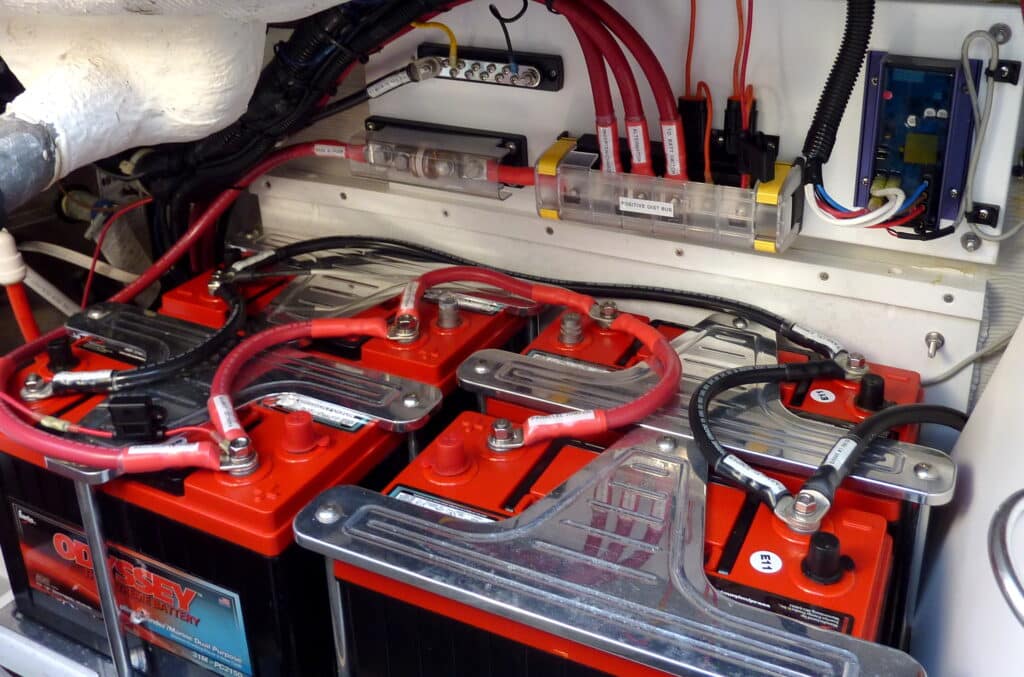
2 AWG is a standard mid-range size for solar battery banks, off-grid inverter hookups, and RV/marine battery interconnects where currents run high but 2/0 AWG's extra copper isn't yet justified. Choose 2 AWG when your continuous DC current sits comfortably below the threshold that would push voltage drop or heat beyond safe limits over your actual cable run length; step up to 2/0 AWG when parallel battery banks, longer runs, or higher-amperage inverters increase the load. As a working rule, longer cable runs and higher continuous currents both push you toward the heavier gauge — if you're unsure which side of that line your system falls on, our team will size it against your exact amp draw and run length.
Two variables actually decide which gauge you need: continuous current draw and total cable run length. Current sets how much heat the conductor has to shed, and run length sets how much resistance the current travels through before reaching the load, so a short run at moderate current stays comfortably within 2 AWG's margin while the same current over a longer run — or two battery banks paralleled onto a shared conductor — pushes resistance and heat past what the smaller gauge is built to handle. That's why we size up to 2/0 AWG only once run length or current actually demands it, not by default.
For battery and inverter builds, we supply four SKUs depending on construction and current path:
- 2 gauge battery cable — the standard 2 AWG battery build (2646/0.127).
- 2/0 gauge battery cable — for higher-current banks and longer runs.
- Flexible battery cable — our broader flexible rubber-insulated battery cable line spanning multiple gauges.
- Battery parallel cable — pre-configured interconnects for linking battery banks in parallel.
All four are part of our wider battery cable category, which covers SAE J1127 and RoHS certified constructions with 36 AWG stranding per SAE J1127 (Class 6 per IEC 60228) — the fine stranding that gives battery cable its flexibility for tight enclosure routing.
Welding Applications
2 AWG welding cable is sized for mid-duty MIG, TIG and stick welding circuits where the machine's rated output current and duty cycle call for more copper than 4 AWG but less than 1/0. Our #2 welding cable is rated for 225–375 A depending on the welder's duty cycle, assuming no single continuous weld exceeds 5 minutes — a critical distinction, since continuous-duty applications need to be sized down from the peak rating, not up to it.
Sizing starts from the welder's nameplate output current and duty-cycle percentage, not the cable gauge alone. A machine rated for a high peak current but a low duty cycle draws far less average heat over a working cycle than one running near-continuous welds at the same peak current, so two welders with identical peak ratings can call for different cable sizes once duty cycle is factored in. Matching the cable to the nameplate, rather than defaulting to a bigger gauge, keeps the circuit's operating temperature inside its rated range.
We supply three welding cable lines at 2 AWG:
- H01N2-D/E welding cable 2 AWG — rated for -25°C to +80°C in flexible use (fixed installation extends this to -40°C to +80°C), with a flexing bend radius of 12×OD (7.5×OD when fixed) and flame retardance to IEC 60332.
- EPDM flexible welding cable — built to SAE J1127 at 600V, with a tighter flexible bend radius of 6×OD and a wider operating range of -50°C to +105°C for cold-climate or high-heat welding bays.
- 0361TQ welding cable — rated to 85°C, our standard mid-temperature welding construction.
All three sit within our broader welding cables category, and every welding cable we ship is 99.9% pure copper, produced in an ISO 9001 certified factory and verified by SGS through Alibaba's supplier assessment. We supply by the foot as well as full production runs — a standard 10,000 m order ships in 7–10 days, so custom lengths don't have to wait behind a factory queue built for bulk orders only.
2 AWG converts exactly to 33.6 mm²; our datasheets label the same gauge 35 mm² for the 1×35 battery cable and 32 mm² for the 1×32 EPDM welding cable — which label applies depends on the construction you order.
2 AWG vs 2/0 AWG
The core difference is cross-sectional area: 2 AWG runs approximately 33.6 mm² (35 mm² nominal) against 2/0 AWG's approximately 67.4 mm² (70 mm² nominal) — roughly double the copper. That extra copper drops resistance and raises safe continuous current, at the cost of a noticeably thicker, stiffer, heavier cable (12 mm OD and 373 kg/km for 2 AWG battery cable versus 17 mm OD and 653 kg/km for 2/0 AWG).
Pick 2 AWG when your system's continuous current and cable run length keep voltage drop and heat within margin on the smaller conductor — this covers most single-battery-bank inverter setups and standard welding circuits. Pick 2/0 AWG when you're paralleling multiple battery banks, running longer cable lengths, or feeding a higher-output inverter or welder where 2 AWG's resistance would either overheat the cable or drop too much voltage before the current reaches the load. For a full side-by-side breakdown with resistance and ampacity tables, see our dedicated 2 AWG vs 2/0 AWG comparison — the SKU sections on this page are where you'll find the actual part numbers once you've decided which gauge fits your load.
2 AWG vs 2/0 AWG — battery cable specifications
Five dimensional and mass figures per size (bars normalised within each row)
2 AWG — battery2/0 AWG — battery
Cross-section (mm²)
2.0×
Conductor OD (mm)
1.3×
Insulation thickness (mm)
1.3×
Cable OD (mm)
1.4×
Weight (kg/km)
1.8×
Source: KMCABLE product spec tables for 2 AWG battery cable and 2/0 AWG battery cable. Bars are normalised within each row (100% = the larger of the two values); wall thickness and weight are construction-specific. Conductor construction: 2646/0.127 (2 AWG) vs 5292/0.127 (2/0 AWG) — conductor resistance quoted per application conditions (12h).
2/0 AWG carries exactly twice the cross-section of 2 AWG (67.4 vs 33.6 mm²) and weighs 1.8× as much (653 vs 373 kg/km), with a 2.04 mm versus 1.53 mm insulation wall and a 17 mm versus 12 mm cable OD.
2 AWG Cable FAQ
Is 2 AWG the same as 35 mm²?
What amp rating does 2 AWG cable carry?
2 AWG or 2/0 AWG — which should I use for a battery bank?
Can I use welding cable for a battery application?
Why does the site show both 32 mm² and 35 mm² for 2 AWG?
How fast can I get custom-length 2 AWG cable by the foot?
Photos: 2 AWG Cable & Production


2 AWG Cable Guides

Get a 2 AWG Cable Quote in 12 Hours
Whether you need 2 AWG battery cable for an inverter build or 2 AWG welding cable by the foot for a production run, our cable team confirms specs, certifications and lead time for your exact build. Message us on WhatsApp at +86 183 2195 9316 or send your details through the quote form below.
Our cable team replies in 12 hours. What to send: current draw · run length · installation method · quantity · certification needed.
WhatsApp our teamGet Professional Quote Now
Get Quotation by Upload Specification Sheet